Email data changes constantly.
A business email address that worked yesterday may become inactive today. A prospect may change companies, a mailbox may be deleted, or a domain may stop accepting email.
For businesses running sales outreach, cold email, recruitment campaigns, lead generation, or email marketing, using outdated email data can lead to unnecessary bounces, wasted resources, and poor campaign performance.
That's why real-time email verification has become an important part of modern email data management.
Instead of waiting for delivery failures to discover problematic addresses, businesses can verify email addresses before sending and make faster, more informed decisions about their contact lists.
What Is Real-Time Email Verification?
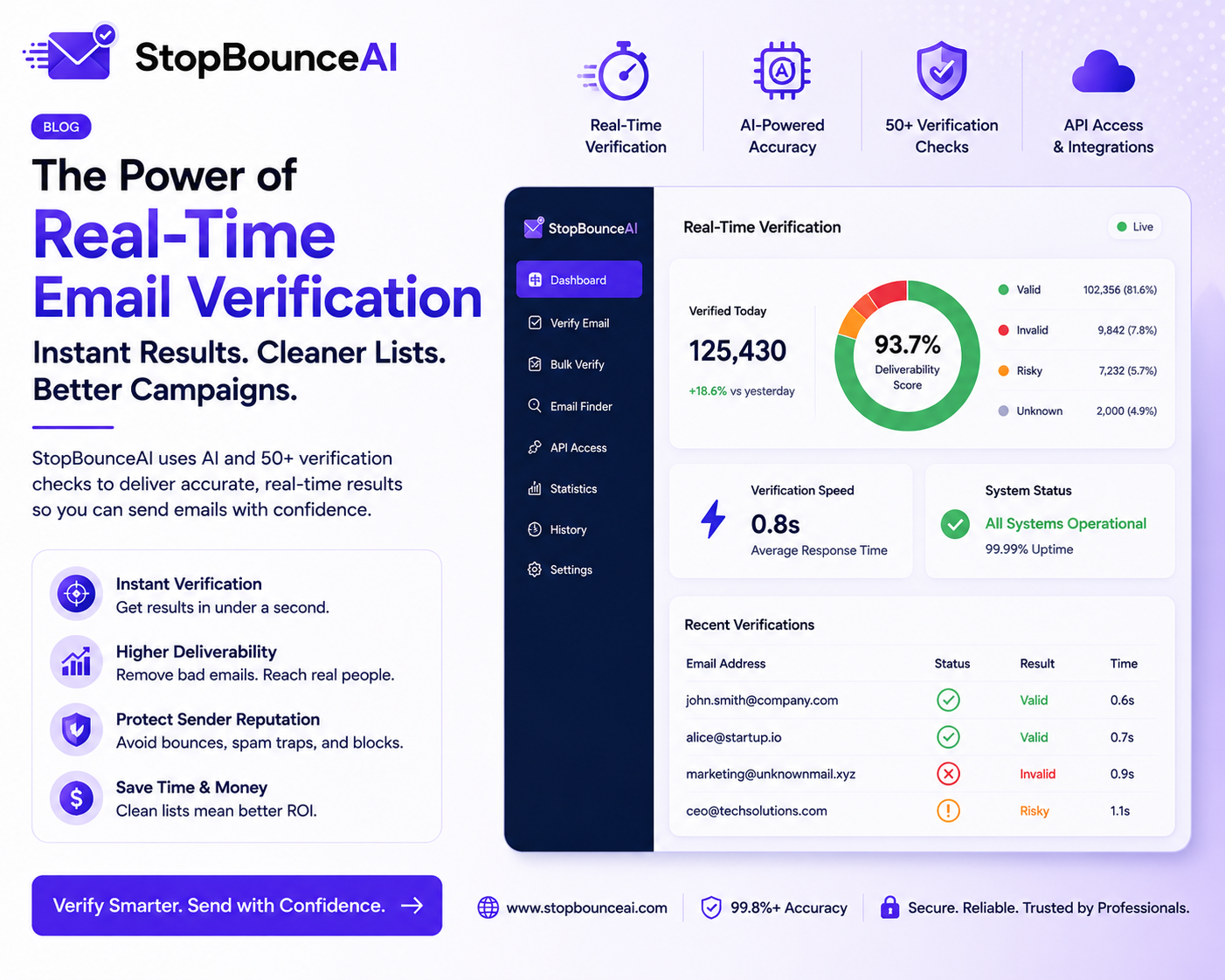
Real-time email verification is the process of checking an email address immediately and returning verification results within seconds or near real time.
A real-time email verification system can analyze multiple signals to determine whether an email address appears valid, deliverable, or risky.
These checks can include:
- Email syntax
- Domain validity
- MX records
- SMTP responses
- Mailbox signals
- Disposable email detection
- Catch-all detection
- Spam-related signals
- Risk analysis
The purpose is simple:
Verify the email before you send the email.
This allows businesses to identify problematic addresses while the data is still being collected or before it enters an active campaign.
Why Is Real-Time Email Verification Important?
Traditional list cleaning often happens after a problem occurs.
- A campaign is sent.
- Emails bounce.
- The team reviews the failed addresses.
- The database is cleaned.
- Then the process starts again.
Real-time verification changes this workflow.
Instead of:
Send → Bounce → Investigate → Clean
businesses can use:
Verify → Analyze → Clean → Send
This proactive approach can help reduce avoidable delivery failures and improve the quality of email data.
How Does Real-Time Email Verification Work?
A real-time verification process can evaluate an email address through several layers.
1. Syntax Check
The system first checks whether the email address follows an acceptable format.
For example:
john@company.com
has a valid structure.
An address such as:
john@
does not.
This basic check helps identify obvious errors immediately.
2. Domain Verification
The system checks whether the domain associated with the email address exists.
For example:
john@company.com
requires company.com to exist as a valid domain.
If the domain doesn't exist, the address is unlikely to be deliverable.
3. MX Record Check
MX records identify the mail servers responsible for receiving email for a domain.
Checking MX records provides an important signal about whether the domain has email infrastructure configured to receive messages.
4. SMTP Verification
SMTP verification can communicate with the receiving mail infrastructure to gather additional information about the address.
This provides a deeper signal than checking the format or domain alone.
However, receiving servers may use different security and anti-abuse measures, so SMTP results should be considered together with other verification signals.
5. Disposable Email Detection
Disposable email addresses are temporary accounts created for short-term use.
They can be useful for temporary registrations but may be unsuitable for:
- B2B sales
- Cold email
- Recruitment
- Lead generation
- CRM databases
- Long-term customer communication
Real-time verification can identify known disposable email providers before these addresses enter your campaign.
6. Catch-All Detection
Catch-all domains accept email for multiple addresses, making it difficult to determine whether a specific mailbox exists.
For example:
anything@company.com
may receive an acceptance response even if the specific mailbox does not belong to an actual user.
Identifying catch-all domains helps businesses understand this uncertainty before sending.
7. Risk Analysis
Not every email address is simply valid or invalid.
Some addresses may appear technically deliverable while presenting additional risks.
A comprehensive verification system can classify addresses into categories such as:
- Valid
- Invalid
- Catch-All
- Disposable
- Risky
- Unknown
This gives businesses more information when deciding how to handle their contacts.
Real-Time Verification vs. Batch Verification
Both real-time and batch email verification have their place.
Real-Time Email Verification
Real-time verification is useful when you need to check an address immediately.
Common examples include:
- Website signup forms
- Lead capture
- CRM data entry
- API integrations
- Sales prospecting
- Email finding
- Individual email checks
Batch Email Verification
Batch verification is useful when you already have a large database.
For example:
- 10,000 contacts
- 50,000 contacts
- 100,000 contacts
- Large CRM exports
- Purchased or imported lists
A strong email data strategy can use both approaches.
Real-time verification keeps new data clean.
Batch verification helps clean existing databases.
How Real-Time Verification Improves Email Campaigns
Real-time verification can improve your email workflow in several ways.
Reduce Avoidable Bounces
Invalid addresses can be identified before you send, helping reduce unnecessary hard bounces.
Improve List Quality
Instead of allowing every collected email address into your database, you can evaluate it before using it.
Save Sending Resources
Why spend sending capacity on addresses that are unlikely to receive your emails?
Verification allows teams to focus on better-quality contacts.
Improve Campaign Reporting
Cleaner recipient data can make campaign metrics easier to interpret.
Protect Data Quality
Real-time verification can become part of your data-collection workflow instead of being treated as a one-time cleaning exercise.
Real-Time Email Verification for Lead Generation
Lead-generation companies often collect contact information from multiple sources.
These sources may include:
- Websites
- Lead databases
- Prospecting platforms
- CRM systems
- Events
- Public business information
- Data enrichment tools
The quality of the resulting data can vary significantly.
Adding real-time email verification to the workflow creates an additional quality-control layer.
A typical process can be:
Find → Enrich → Verify → Store → Segment → Outreach
This helps prevent problematic email addresses from entering the final campaign list.
Real-Time Email Verification for B2B Sales
B2B sales teams frequently deal with changing contact information.
A prospect may:
- Change jobs
- Change companies
- Move to a new department
- Receive a new corporate email address
- Become inactive
Real-time verification can help sales teams check an address immediately before using it.
This is particularly useful when representatives are researching prospects and preparing personalized outreach.
Instead of adding every discovered address to the CRM and verifying it later, the address can be evaluated during the workflow.
Real-Time Email Verification for Recruitment
Recruitment teams also depend on accurate email data.
Recruiters communicate with candidates, hiring managers, HR teams, business owners, and potential clients.
Because professional contact information changes frequently, real-time verification can help recruitment teams evaluate addresses before sending important messages.
This can be useful for:
- Candidate outreach
- Employer outreach
- Talent sourcing
- Recruitment campaigns
- Client acquisition
- Hiring campaigns
Real-Time Verification and Email Deliverability
Real-time verification can help improve the quality of your recipient list, but it is important to understand what verification can and cannot do.
Email verification can help identify:
- Invalid emails
- Disposable emails
- Catch-all domains
- Risky addresses
- Other problematic signals
However, verification does not guarantee inbox placement.
Deliverability also depends on:
- Sender reputation
- Domain reputation
- SPF
- DKIM
- DMARC
- Sending volume
- Email content
- Recipient engagement
- Spam complaints
- Receiving-server policies
Real-time verification should therefore be considered one component of a complete email deliverability strategy.
How StopBounceAI Provides Real-Time Email Verification
StopBounceAI is an AI-powered email verification and email finder platform designed to help businesses identify invalid, disposable, catch-all, spam, and risky email addresses.
The platform combines multiple verification signals to provide detailed information about email quality.
Real-Time Verification
Check email addresses quickly and receive verification results without waiting for a large batch process.
AI-Powered Analysis
Use intelligent analysis to evaluate multiple email and risk signals.
50+ Verification Checks
Analyze email addresses across multiple technical and risk-related checkpoints.
Detailed Results
Understand whether an email is valid, invalid, catch-all, disposable, risky, or unknown.
Bulk Verification
Process large contact lists when you need to clean an existing database.
Email Finder
Find professional email addresses and verify them before using them for outreach.
API Access
Integrate real-time email verification directly into your applications, CRM systems, databases, and automated workflows.
How StopBounceAI Fits Into Your Workflow
A modern email workflow can look like this:
Step 1: Find
Discover potential contacts and professional email addresses.
Step 2: Verify
Check the email address in real time.
Step 3: Analyze
Review the verification result and risk indicators.
Step 4: Segment
Separate valid, invalid, catch-all, disposable, risky, and unknown addresses.
Step 5: Store
Add appropriate contacts to your CRM or marketing database.
Step 6: Send
Use cleaner data for your email campaigns.
Step 7: Monitor
Track bounce rates, engagement, replies, and campaign performance.
This creates a proactive approach to email data management.
Why Speed Matters in Email Verification
Speed matters when verification is part of an active workflow.
Imagine a sales representative discovers a prospect's email address while researching a company.
They don't necessarily want to:
- Save the address
- Upload a spreadsheet
- Wait for batch processing
- Download the results
- Return to their workflow
Real-time verification can make this process much simpler.
Find the email → Verify it → Understand the result → Continue the workflow.
The faster the verification process, the easier it becomes to make email verification part of everyday prospecting and data management.
Real-Time Email Verification Through API
Businesses with their own software or data infrastructure can integrate email verification directly into their workflows.
An API can be used to trigger verification automatically when an email address is:
- Added to a CRM
- Submitted through a form
- Discovered by a lead-generation system
- Added to a database
- Entered into an application
- Processed by an automation
This means verification doesn't have to be a separate manual step.
It can become part of the system itself.
Can Real-Time Email Verification Guarantee Delivery?
No.
No email verification service can guarantee that every email will be delivered or reach the inbox.
Email delivery depends on many factors beyond the recipient address.
Verification helps improve recipient-data quality, while successful email delivery also depends on sender reputation, authentication, content, engagement, sending behavior, and receiving-server policies.
The goal is to eliminate as many avoidable data-quality problems as possible before sending.
Frequently Asked Questions
What is real-time email verification?
Real-time email verification is the process of checking an email address immediately and receiving verification results quickly instead of waiting for a large batch process.
Why should I verify emails in real time?
Real-time verification helps businesses evaluate email addresses before adding them to campaigns, CRMs, databases, or workflows.
Can real-time email verification reduce bounce rates?
It can help reduce avoidable bounces by identifying invalid and potentially problematic email addresses before sending.
Is real-time email verification useful for cold email?
Yes. Sales teams can verify prospect email addresses before adding them to cold email campaigns.
Is real-time email verification useful for lead generation?
Yes. Lead-generation businesses can verify newly discovered email addresses before delivering or using the contacts.
Can I use an API for real-time verification?
Yes. API-based verification allows businesses to integrate email verification directly into their own applications, databases, CRMs, and workflows.
Does real-time verification guarantee inbox placement?
No. Email verification evaluates recipient data, but inbox placement depends on many additional deliverability factors.
What types of emails can StopBounceAI identify?
StopBounceAI is designed to identify invalid, disposable, catch-all, spam, and risky email addresses through multiple verification signals.
Conclusion
Email data changes constantly.
Waiting until after a campaign fails to discover problematic email addresses can waste time and resources.
Real-time email verification provides a proactive way to check email addresses before they become a campaign problem.
Instead of:
Send → Bounce → Investigate → Clean
you can build a smarter workflow:
Find → Verify → Analyze → Clean → Send
With StopBounceAI, businesses can combine real-time email verification, AI-powered analysis, 50+ verification checks, detailed risk results, bulk verification, email finding, and API access to maintain cleaner and more reliable email data.
Better data means better decisions.
Verify Smarter. Send With Confidence.
StopBounceAI - AI-Powered Email Verification & Finder
Detect invalid, disposable, catch-all, spam, and risky emails before they become a problem for your campaigns.