Managing a large email database can be difficult.
Whether you're running B2B sales campaigns, cold email outreach, lead generation, recruitment campaigns, or email marketing, your database may contain thousands or even millions of email addresses.
Over time, email data becomes outdated. People change jobs, companies change domains, mailboxes become inactive, and databases can accumulate invalid, disposable, catch-all, spam, and risky email addresses.
Sending campaigns to an unverified database can result in unnecessary bounces, wasted sending resources, and poor-quality campaign data.
That's why bulk email verification is an important part of modern email list management.
With a bulk email verification tool such as StopBounceAI, businesses can upload large contact lists, verify thousands of email addresses, identify problematic contacts, and build cleaner lists before sending.
What Is Bulk Email Verification?
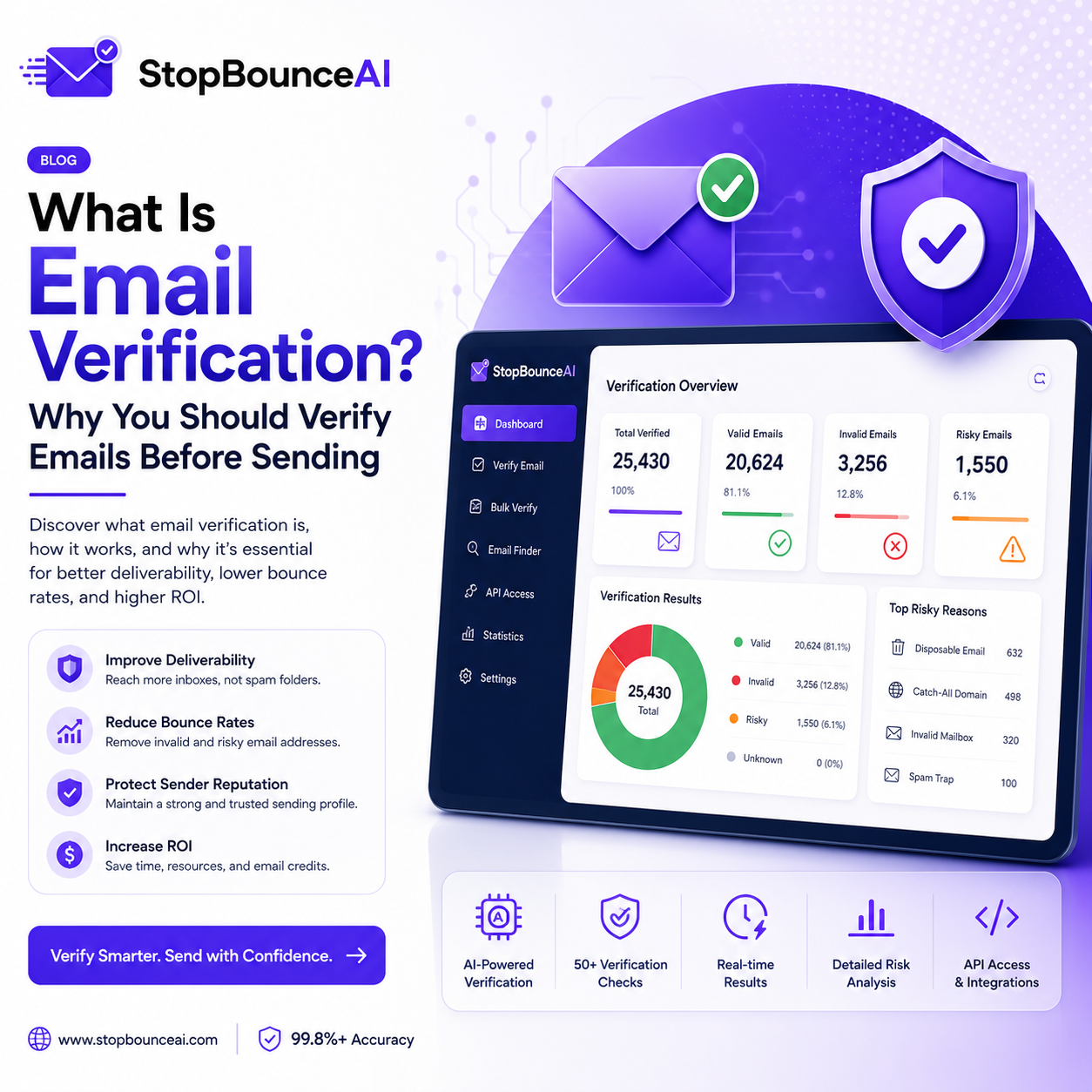
Bulk email verification is the process of checking a large number of email addresses at once to determine their validity, deliverability signals, and potential risks.
Instead of checking email addresses individually, businesses can upload an entire database and process the contacts together.
A bulk email verification system can analyze signals such as:
- Email syntax
- Domain validity
- MX records
- SMTP responses
- Mailbox signals
- Disposable email addresses
- Catch-all domains
- Spam-related indicators
- Risk signals
The results can then be used to separate higher-quality addresses from contacts that may require removal or additional review.
Why Should You Verify Email Lists in Bulk?
Large email databases can contain a significant amount of outdated information.
For example, a company may have a database of 250,000 contacts collected from different sources over several years.
That database could contain:
- Invalid emails
- Duplicate records
- Outdated contacts
- Disposable addresses
- Catch-all domains
- Risky addresses
- Inactive mailboxes
Manually checking 250,000 email addresses isn't practical.
Bulk email verification automates the process so businesses can evaluate large datasets efficiently.
What Are the Benefits of Bulk Email Verification?
1. Clean Large Email Lists
Bulk verification allows businesses to identify problematic addresses across an entire database.
Instead of manually checking individual contacts, you can process the complete list and review the results in one place.
2. Reduce Unnecessary Email Bounces
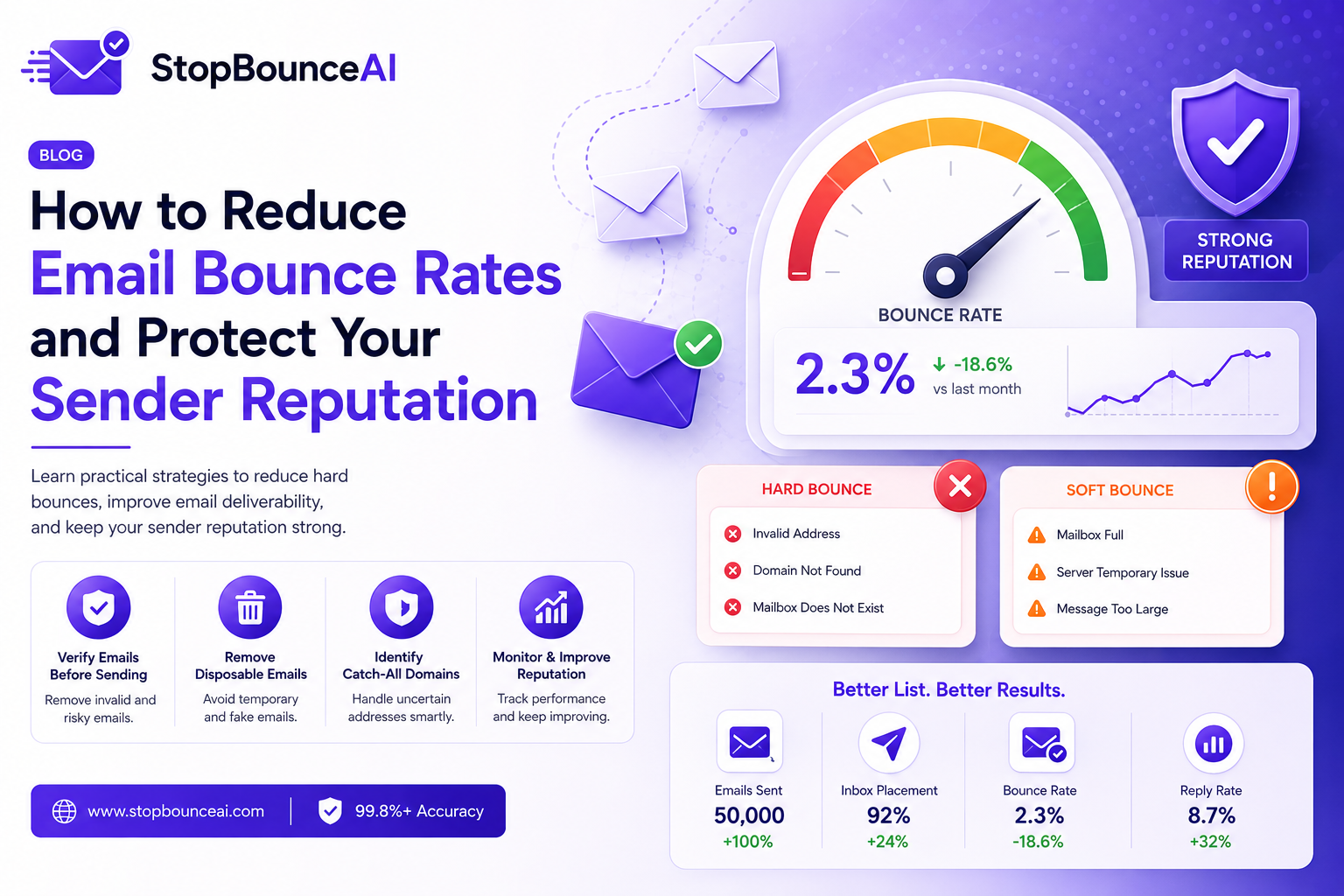
Invalid email addresses are a common cause of hard bounces.
Identifying invalid addresses before sending can help reduce avoidable delivery failures.
While verification cannot eliminate every possible bounce, it can improve the quality of your recipient list.
3. Save Time
Imagine manually checking 50,000 email addresses.
It would require a significant amount of time and effort.
Bulk email verification automates the process and allows your team to focus on sales, marketing, recruitment, and other important activities.
4. Improve Data Quality
A clean database is more valuable than a large database filled with outdated contacts.
Bulk verification can help businesses identify:
- Invalid addresses
- Disposable emails
- Catch-all domains
- Risky emails
- Other problematic records
This makes your database easier to manage and more useful for future campaigns.
5. Improve Campaign Efficiency
Sending emails to addresses that are unlikely to receive them wastes sending capacity.
By cleaning your database before sending, your team can focus on better-quality contacts.
This can make campaign reporting and performance analysis more meaningful.
How Does Bulk Email Verification Work?
A typical bulk email verification process looks like this:
Upload → Verify → Analyze → Clean → Download → Send
Let's look at each step.
Step 1: Upload Your Email List
Start by uploading your contact database.
Depending on the platform, your file may contain thousands or hundreds of thousands of email addresses.
Common formats include:
- CSV
- XLSX
- TXT
Your list can come from your CRM, lead-generation platform, marketing database, event registrations, or other sources.
Step 2: Automated Verification
The verification system processes the email addresses and performs multiple checks.
These may include:
- Syntax checks
- Domain checks
- MX checks
- SMTP checks
- Disposable email detection
- Catch-all detection
- Risk analysis
The system then assigns results to individual email addresses.
Step 3: Analyze Verification Results
After verification, your database can be divided into different categories.
For example:
Valid
The available signals indicate that the email address is likely deliverable.
Invalid
The address appears unlikely to receive email.
Disposable
The address appears to belong to a temporary email provider.
Catch-All
The domain accepts email broadly, making individual mailbox verification more difficult.
Risky
Additional signals indicate that the address may carry increased delivery or reputation risk.
Unknown
There isn't enough reliable information to confidently classify the address.
Example of a Bulk Verification Result
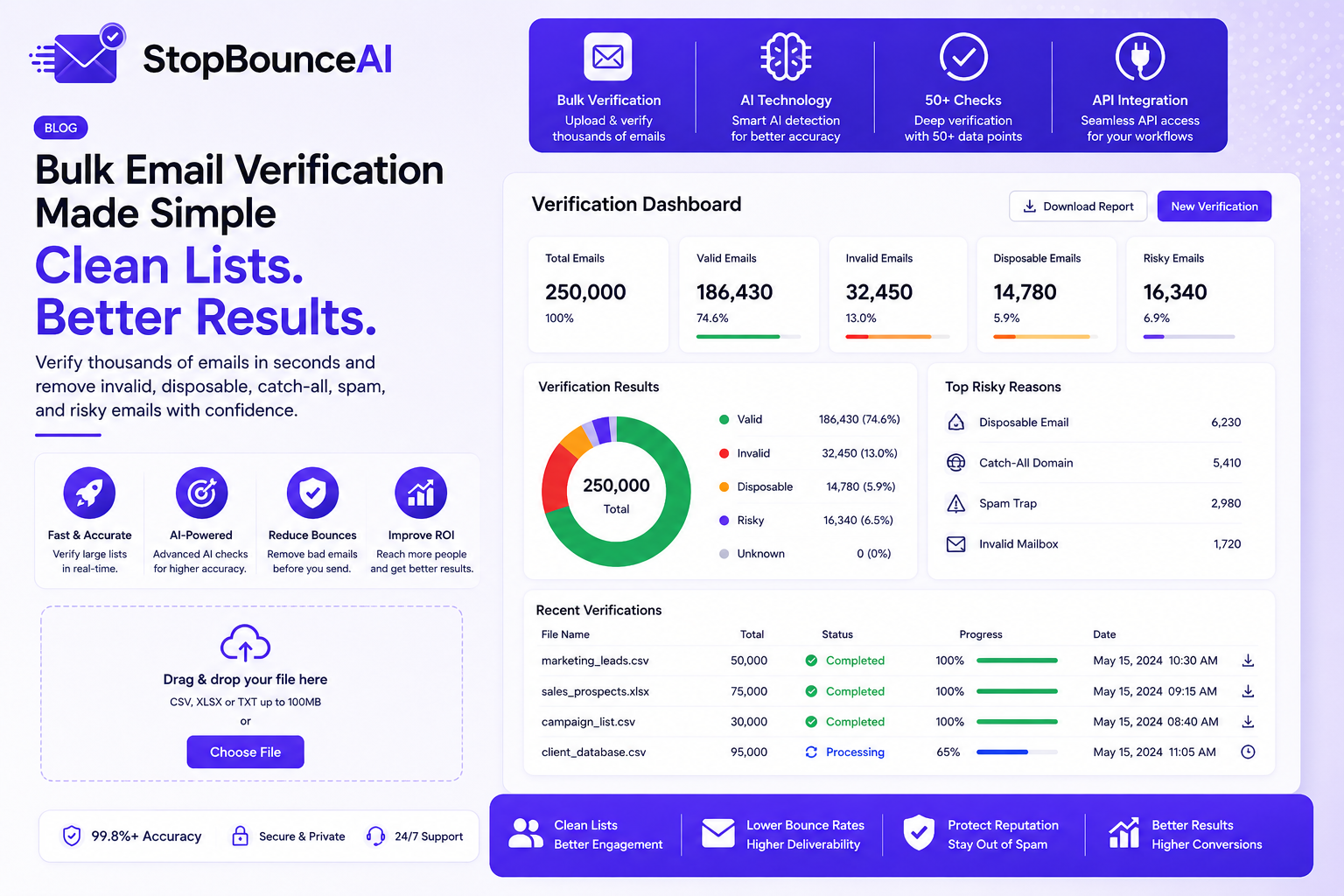
Imagine you upload 250,000 email addresses.
Your verification results might look like:
| Result | Number of Emails |
|---|---|
| Valid | 186,430 |
| Invalid | 32,450 |
| Disposable | 14,780 |
| Risky | 16,340 |
The exact distribution will depend on the quality and source of your database.
The important point is that bulk verification gives you visibility into the quality of your data before you use it in an email campaign.
Bulk Email Verification for B2B Lead Generation
B2B lead-generation companies often manage large databases.
A lead list may contain:
- CEOs
- Founders
- Sales Directors
- Marketing Managers
- HR Leaders
- Recruiters
- Procurement Managers
- Business Owners
- Department Heads
However, professional contact information changes constantly.
Employees change jobs, companies change domains, and mailboxes become inactive.
Bulk email verification allows lead-generation teams to check large datasets before delivering them to clients or using them for campaigns.
A typical workflow can be:
Find Leads → Enrich Data → Bulk Verify → Clean → Segment → Deliver
Bulk Email Verification for Cold Email
Cold email campaigns depend heavily on list quality.
Sending a campaign to an old or unverified database can create unnecessary delivery problems.
Before launching a campaign, businesses can use bulk email verification to identify problematic addresses.
A simple cold email workflow is:
Build Prospect List → Verify Emails → Remove Invalid Addresses → Segment Risky Contacts → Launch Campaign → Monitor Results
This creates a more controlled outbound process.
Bulk Email Verification for Recruitment
Recruitment companies can also benefit from bulk email verification.
Recruiters often maintain large databases of:
- Candidates
- Hiring managers
- HR professionals
- Employers
- Business owners
- Recruitment contacts
These databases can become outdated quickly.
Bulk verification allows recruitment teams to process large contact lists and identify addresses that may require removal or review before outreach.
Bulk Email Verification for Marketing Teams
Marketing teams frequently manage large subscriber and customer databases.
Before launching an important campaign, marketers can verify their lists to identify problematic addresses.
This can help improve:
- Database quality
- Campaign efficiency
- Email reporting
- Sending resource utilization
- Contact management
Email verification should be combined with proper consent, compliance, authentication, and responsible sending practices.
What Is the Difference Between Bulk Verification and Real-Time Verification?
Both approaches are useful, but they solve different problems.
Real-Time Email Verification
Real-time verification is useful when checking an email address immediately.
For example:
New Lead → Verify Immediately → Add to CRM
It's useful for:
- Website forms
- Lead capture
- Email finding
- CRM workflows
- API integrations
Bulk Email Verification
Bulk verification is useful when you already have a large database.
For example:
250,000 Contacts → Upload → Verify → Download Results
It's useful for:
- CRM cleaning
- Marketing databases
- Lead lists
- Recruitment databases
- Old contact lists
- Large prospect databases
The best email data strategy can use both.
How Many Emails Can You Verify in Bulk?
The number of emails you can verify depends on the verification platform, plan, infrastructure, and processing limits.
For large databases, businesses should consider:
- Maximum file size
- Verification limits
- Processing speed
- API limits
- Result export options
- Data security
- Accuracy
- Cost per verification
StopBounceAI is designed to support businesses that need to process large email datasets efficiently.
Why Email Verification Accuracy Matters
Bulk verification is useful only when the results provide meaningful information.
A verification platform should evaluate multiple signals instead of relying on a single basic check.
For example, simply confirming that:
john@company.com
has the correct format does not prove that John's mailbox exists.
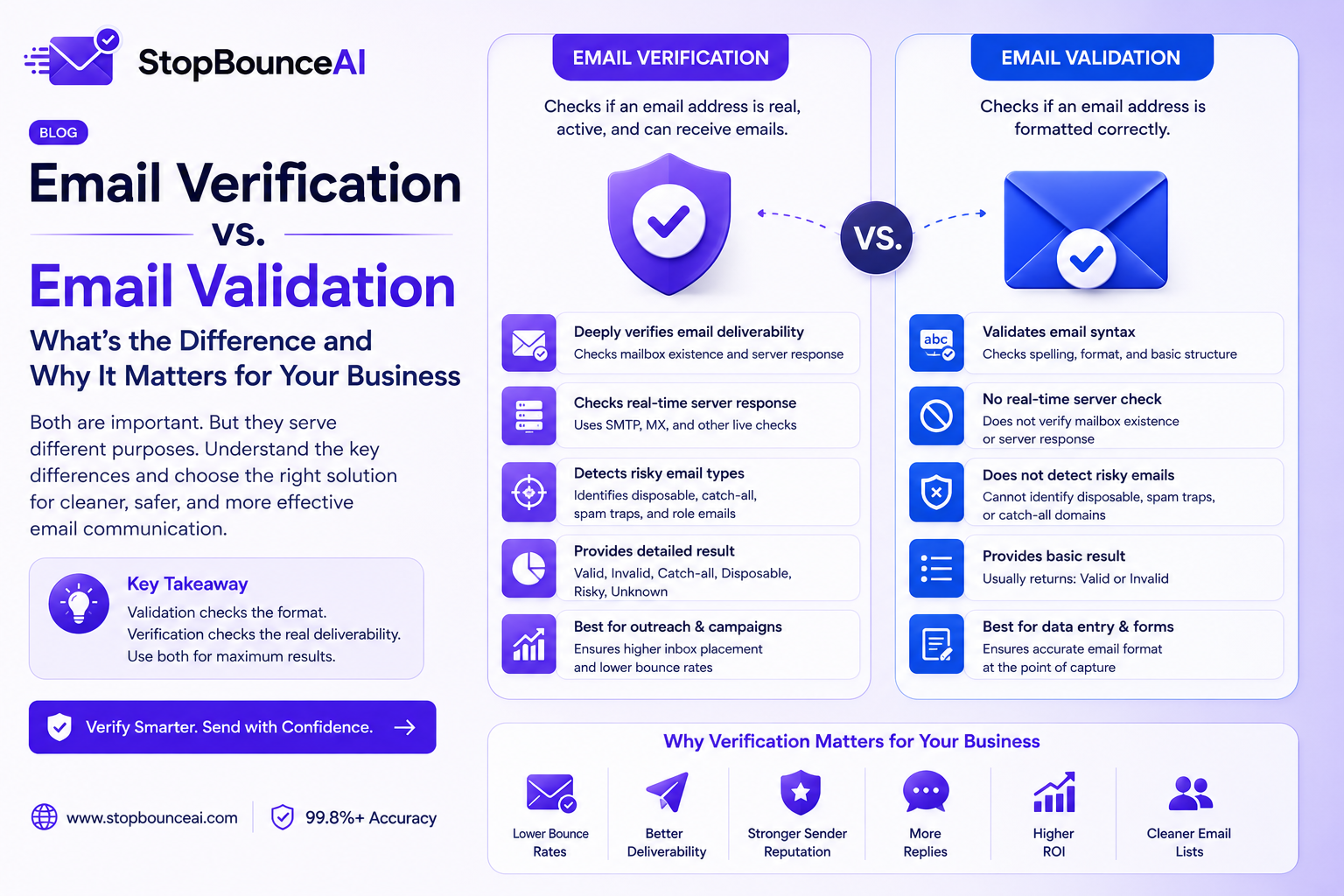
A deeper verification process can analyze domain, MX, SMTP, disposable, catch-all, and other risk signals.
This provides a more complete picture of the email address.
50+ Verification Checks
StopBounceAI is designed around 50+ verification checkpoints to evaluate email addresses across multiple technical and risk-related signals.
These checks can help identify different types of problematic addresses, including:
- Invalid emails
- Disposable emails
- Catch-all domains
- Spam-related risks
- Risky addresses
- Other verification issues
Using multiple verification signals provides more information than basic email-format validation.
How StopBounceAI Helps With Bulk Email Verification
StopBounceAI is an AI-powered email verification and email finder platform designed to help businesses clean and verify large contact databases.
With StopBounceAI, businesses can use:
Bulk Email Verification
Upload large email lists and verify contacts efficiently.
AI-Powered Verification
Analyze multiple signals to identify potential email risks.
50+ Verification Checks
Evaluate email addresses through multiple technical and risk-related checkpoints.
Detailed Results
Understand whether an address is valid, invalid, disposable, catch-all, risky, or unknown.
Downloadable Results
Export verification results and use the cleaned data in your existing workflows.
Email Finder
Find professional email addresses and verify them before using them for outreach.
API Access
Integrate email verification directly into your CRM, applications, databases, and automated workflows.
A Simple Bulk Email Verification Workflow
You can build a reliable email-cleaning process with a few simple steps.
Step 1: Collect Your Data
Gather contacts from your CRM, prospecting tools, website, events, or other sources.
Step 2: Remove Duplicates
Clean obvious duplicate records before verification.
Step 3: Upload Your List
Upload your email database to your verification platform.
Step 4: Verify
Run your entire list through the verification process.
Step 5: Review Results
Analyze valid, invalid, disposable, catch-all, risky, and unknown results.
Step 6: Clean Your Database
Remove or segment addresses according to your campaign strategy.
Step 7: Launch Your Campaign
Use the cleaned list for your email outreach or marketing campaign.
Step 8: Monitor Performance
Track bounce rates, engagement, replies, and other campaign metrics.
Can Bulk Email Verification Guarantee Delivery?
No.
Email verification can help improve recipient-data quality, but it cannot guarantee delivery or inbox placement.
Email deliverability also depends on:
- Sender reputation
- Domain reputation
- SPF
- DKIM
- DMARC
- Email content
- Sending volume
- Recipient engagement
- Spam complaints
- Receiving-server policies
Bulk verification should therefore be treated as one part of a broader email deliverability strategy.
Frequently Asked Questions
What is bulk email verification?
Bulk email verification is the process of checking a large number of email addresses simultaneously to identify invalid, disposable, catch-all, risky, and other problematic addresses.
Why should I verify my email list in bulk?
Bulk verification allows businesses to clean large databases efficiently, reduce avoidable bounces, improve data quality, and prepare better lists for email campaigns.
Can I verify thousands of email addresses at once?
Yes. Bulk email verification platforms are designed to process large numbers of email addresses more efficiently than manual verification.
Is bulk email verification useful for cold email?
Yes. Verifying a prospect list before a cold email campaign can help identify problematic addresses and improve the quality of your sending list.
Is bulk email verification useful for B2B lead generation?
Yes. B2B lead databases can become outdated quickly, making regular verification useful for maintaining contact-data quality.
Can bulk email verification reduce bounce rates?
It can help reduce avoidable bounces by identifying addresses that appear invalid or problematic before sending.
Does verification guarantee that an email reaches the inbox?
No. Email verification evaluates recipient data, while inbox placement depends on many additional factors.
How often should I verify my email list?
The right frequency depends on how quickly your database changes and how frequently you send emails. New lists should generally be verified before use, while older databases can be reverified periodically.
Conclusion
Large email databases can contain thousands of outdated, invalid, disposable, catch-all, spam, and risky email addresses.
Sending to these addresses can waste resources and create unnecessary delivery problems.
Bulk email verification provides a simple way to evaluate large databases before sending.
Instead of manually checking contacts one by one, you can:
Upload → Verify → Analyze → Clean → Download → Send
With StopBounceAI, businesses can verify large email lists using AI-powered analysis, 50+ verification checks, detailed results, bulk processing, email finding, and API access.
Build cleaner lists.
Reduce avoidable bounces.
Improve your email-data workflow.
Verify Smarter. Send With Confidence.
StopBounceAI - AI-Powered Email Verification & Finder
Detect invalid, disposable, catch-all, spam, and risky emails before they become a problem for your campaigns.