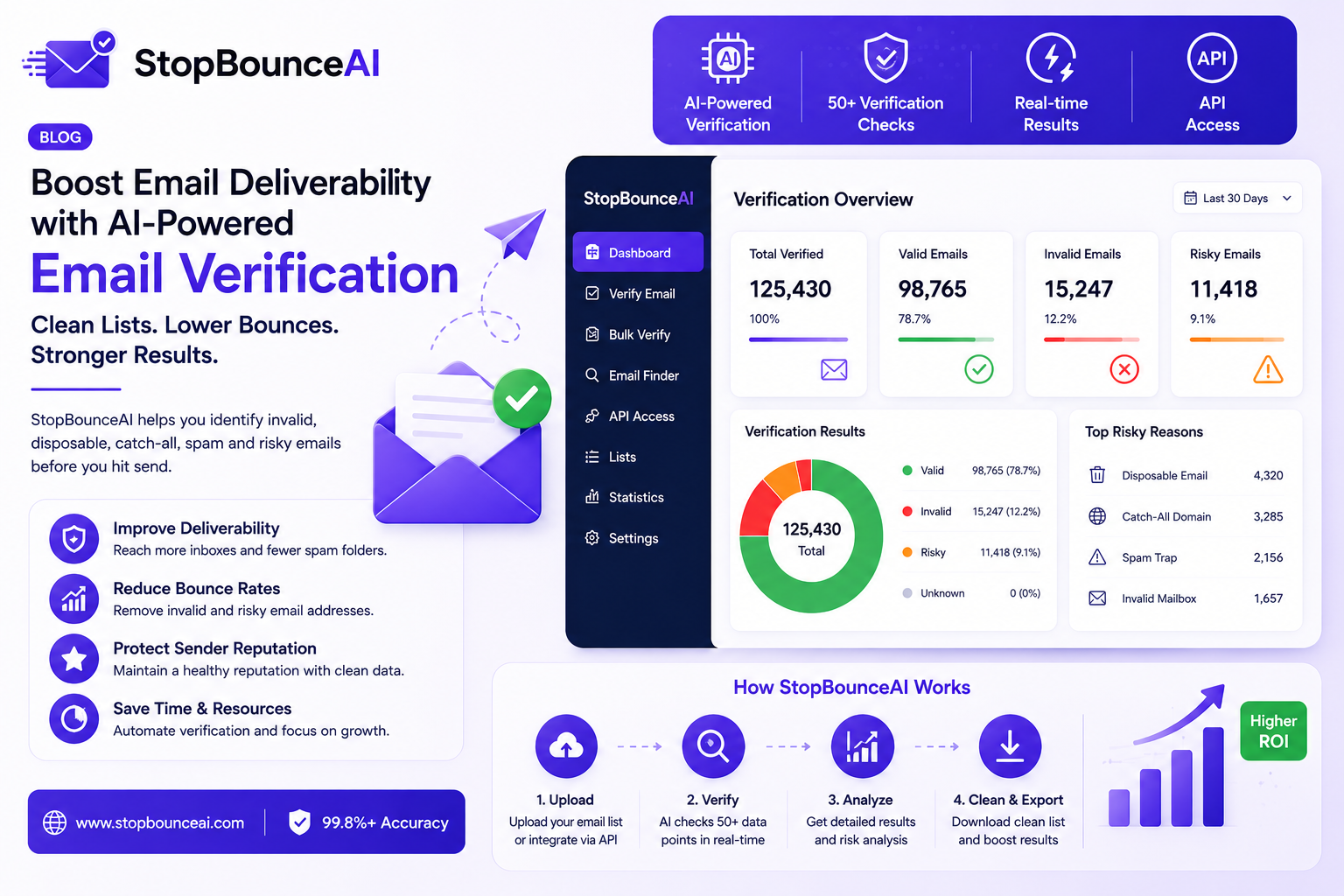
Email deliverability is one of the most important factors behind a successful email campaign. You can have a great offer, a strong subject line, and a highly targeted audience, but if your emails don't reach real recipients, your campaign cannot generate the results you expect. One of the biggest challenges businesses face is poor-quality email data. Email databases can contain invalid, outdated, disposable, catch-all, spam-trap, and risky email addresses. Sending campaigns to these addresses can increase unnecessary bounces, waste sending resources, and make it harder to maintain a healthy sender reputation. This is where AI-powered email verification can help. With technologies such as StopBounceAI, businesses can analyze email addresses using multiple verification signals before sending campaigns, helping them build cleaner lists and make smarter sending decisions.
What Is AI-Powered Email Verification?
AI-powered email verification is the process of using automated intelligence and multiple verification signals to evaluate the quality, deliverability, and potential risk of an email address. Traditional email checking may focus primarily on basic formatting or individual technical checks. AI-powered verification can combine multiple signals to provide a more complete picture of an email address.
These signals can include:
- Email syntax
- Domain information
- MX records
- SMTP responses
- Mailbox signals
- Disposable email detection
- Catch-all detection
- Spam-related indicators
- Risk analysis
- Domain and infrastructure signals
The goal is not simply to determine whether an email "looks correct." The goal is to help answer:
"Is this email address worth sending to?"
Why Does Email Deliverability Matter?
Email deliverability refers to the ability of your emails to successfully reach recipients. A campaign can fail for many reasons.
Your emails may:
- Bounce
- Be rejected
- Be filtered
- Go to spam
- Reach inactive accounts
- Be sent to addresses that no longer exist
Poor-quality recipient data can contribute to unnecessary delivery failures. For sales teams, marketers, recruiters, and lead-generation agencies, this can mean fewer opportunities from the same amount of sending effort. That's why email data quality should be treated as an important part of your overall deliverability strategy.
How Poor Email Data Affects Your Campaigns
Imagine you have a database containing 100,000 email addresses. You may assume that every address is ready for outreach. But your database could contain:
- Invalid emails
- Inactive mailboxes
- Disposable emails
- Catch-all domains
- Spam traps
- Risky addresses
- Outdated contacts
If you send to all 100,000 addresses without checking them, some percentage may fail. Those failures can result in:
Poor data → More bounces → Less efficient campaigns → More delivery concerns
Email verification provides a quality-control step before sending.
How AI-Powered Email Verification Works
A modern email verification platform can evaluate multiple signals before providing a final result.
Step 1: Syntax Analysis
The system checks whether the email address follows an acceptable format.
For example:
john@company.com
has a valid structure.
An address such as:
john@
does not.
This is the first layer of verification.
Step 2: Domain Verification
The system checks whether the email domain exists and appears to have valid email infrastructure.
For example:
john@company.com
requires the company.com domain to exist.
Step 3: MX Record Analysis
MX records identify the mail servers responsible for receiving email for a domain. Checking MX records provides an important signal about whether a domain is configured to receive email.
Step 4: SMTP Verification
SMTP-level verification can interact with receiving mail infrastructure to gather additional information about the email address. This provides a deeper signal than checking formatting alone. However, different mail servers use different security and anti-abuse measures, so SMTP results should be interpreted alongside other verification signals.
Step 5: Disposable Email Detection
Disposable email addresses are temporary addresses designed for short-term use. They may be unsuitable for many business campaigns because they can become inactive quickly. AI-powered verification can identify known disposable email providers and classify those addresses accordingly.
Step 6: Catch-All Detection
Catch-all domains accept email for multiple addresses, making it difficult to determine whether an individual mailbox actually exists. For example:
anything@company.com
may receive an acceptance response even when "anything" is not a real employee mailbox. Identifying catch-all domains helps businesses understand this uncertainty before sending.
Step 7: Risk Analysis
Some addresses cannot simply be classified as valid or invalid. An email may appear technically deliverable while still presenting additional risk. A deeper verification process can therefore classify addresses into categories such as:
- Valid
- Invalid
- Catch-All
- Disposable
- Risky
- Unknown
This provides more useful information for campaign planning.
How AI Email Verification Improves Deliverability
AI-powered email verification can improve your email-data workflow in several ways.
1. Identify Invalid Emails Before Sending
Invalid addresses are one of the most obvious causes of hard bounces. Identifying them before a campaign allows you to remove them from your active sending list.
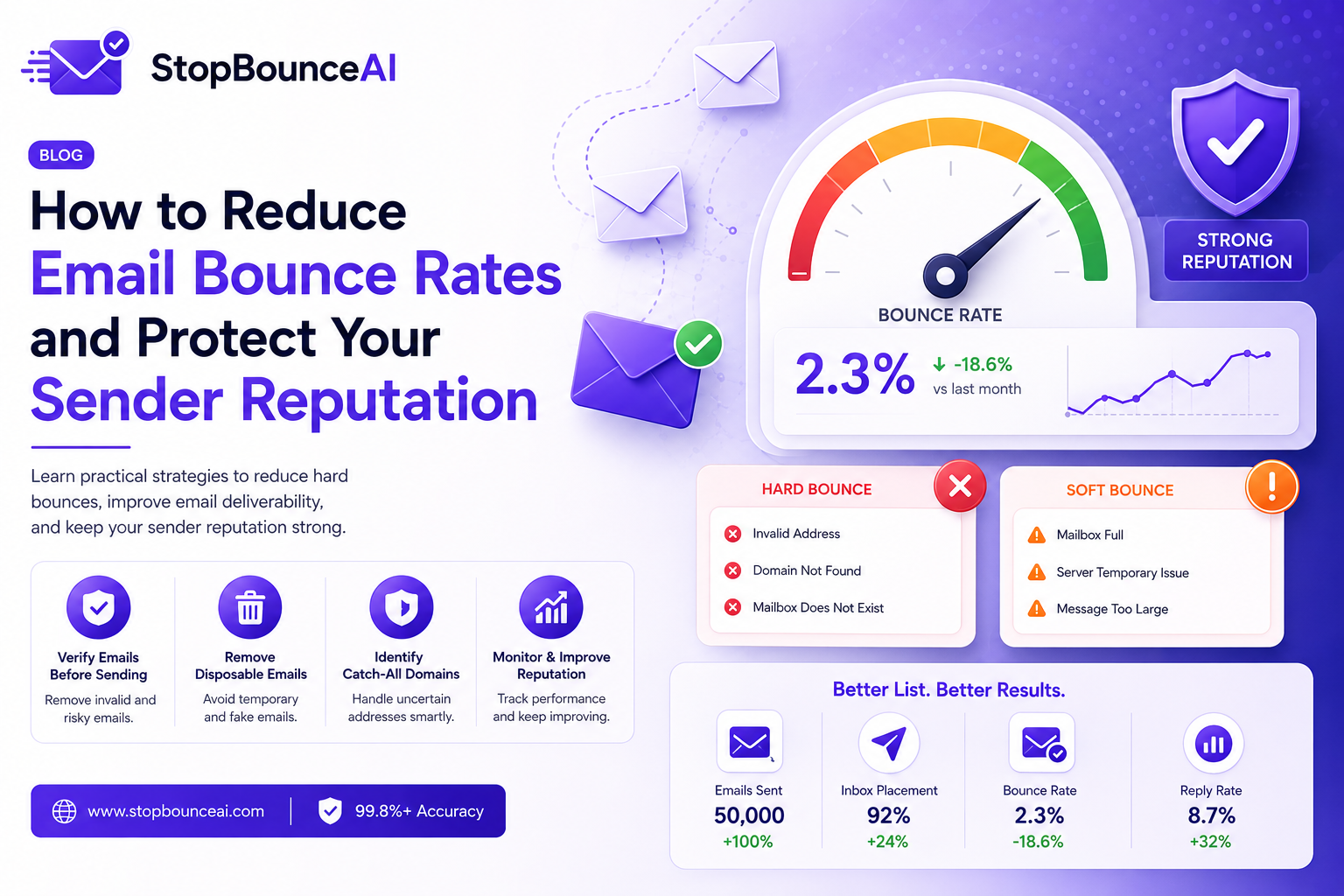
2. Reduce Unnecessary Bounces
When problematic addresses are removed before sending, your campaigns can avoid many preventable delivery failures. This doesn't eliminate every possible bounce, but it can improve the quality of your recipient list.
3. Improve Email List Quality
A clean email list is easier to manage and more useful for sales and marketing teams. Verification helps identify problematic records so that your database can be cleaned and segmented.
4. Protect Sending Reputation
Sender reputation depends on many factors, including recipient engagement, spam complaints, authentication, sending practices, and bounce behavior. Maintaining clean recipient data is an important part of responsible email sending.
5. Improve Campaign Efficiency
Why spend sending resources on addresses that are unlikely to generate an opportunity? By identifying problematic addresses before sending, teams can focus their campaigns on better-quality contacts.
How Better Email Data Can Improve ROI
Email verification isn't only about preventing bounces. It's also about using your resources more efficiently.
Suppose you have a database of 100,000 contacts. If thousands of those addresses are invalid or unsuitable for your campaign, sending to them consumes resources without creating additional opportunities. A cleaner list allows you to focus your campaign on contacts with stronger potential.
This can help improve:
- Campaign efficiency
- Reply rates
- Sales productivity
- Lead quality
- Reporting accuracy
- Resource utilization
The exact impact depends on your list quality, campaign strategy, audience, and sending practices.
AI Email Verification for B2B Sales
B2B sales teams often work with large prospect databases. These databases may include:
- CEOs
- Founders
- Sales leaders
- Marketing executives
- HR professionals
- Procurement managers
- Business owners
- Department heads
Contact information changes constantly. People change companies. Businesses change domains. Mailboxes become inactive. Verifying email addresses before outreach can help sales teams maintain cleaner prospect databases and reduce unnecessary delivery failures.
AI Email Verification for Cold Email
Cold email campaigns depend heavily on contact-data quality. A simple outbound workflow can be:
Find Leads → Enrich Contacts → Verify Emails → Segment Results → Send → Monitor
Verification can help identify problematic addresses before they reach your sending platform.
For example, your team can separate:
- Valid - Potentially suitable for normal outreach.
- Invalid - Should generally be removed from the campaign.
- Disposable - May be unsuitable for long-term business outreach.
- Catch-All - Requires additional consideration because mailbox existence is difficult to confirm.
- Risky - Should be reviewed according to your campaign strategy.
AI Email Verification for Lead Generation
Lead-generation agencies and data providers often process thousands or millions of contact records. The bigger the database, the more difficult it becomes to manually check every address. Automated email verification can help organizations process large volumes of data efficiently.
A lead-generation workflow can therefore become:
Discover → Enrich → Verify → Clean → Segment → Deliver
This helps ensure that contact data is evaluated before it reaches the sales team.
AI Email Verification for Recruitment
Recruitment companies also depend heavily on accurate email data. Recruiters may contact:
- Candidates
- Hiring managers
- HR professionals
- Business owners
- Talent acquisition teams
- Employers
Because professional contact information changes frequently, verification can help recruiters maintain cleaner databases and reduce avoidable delivery failures.
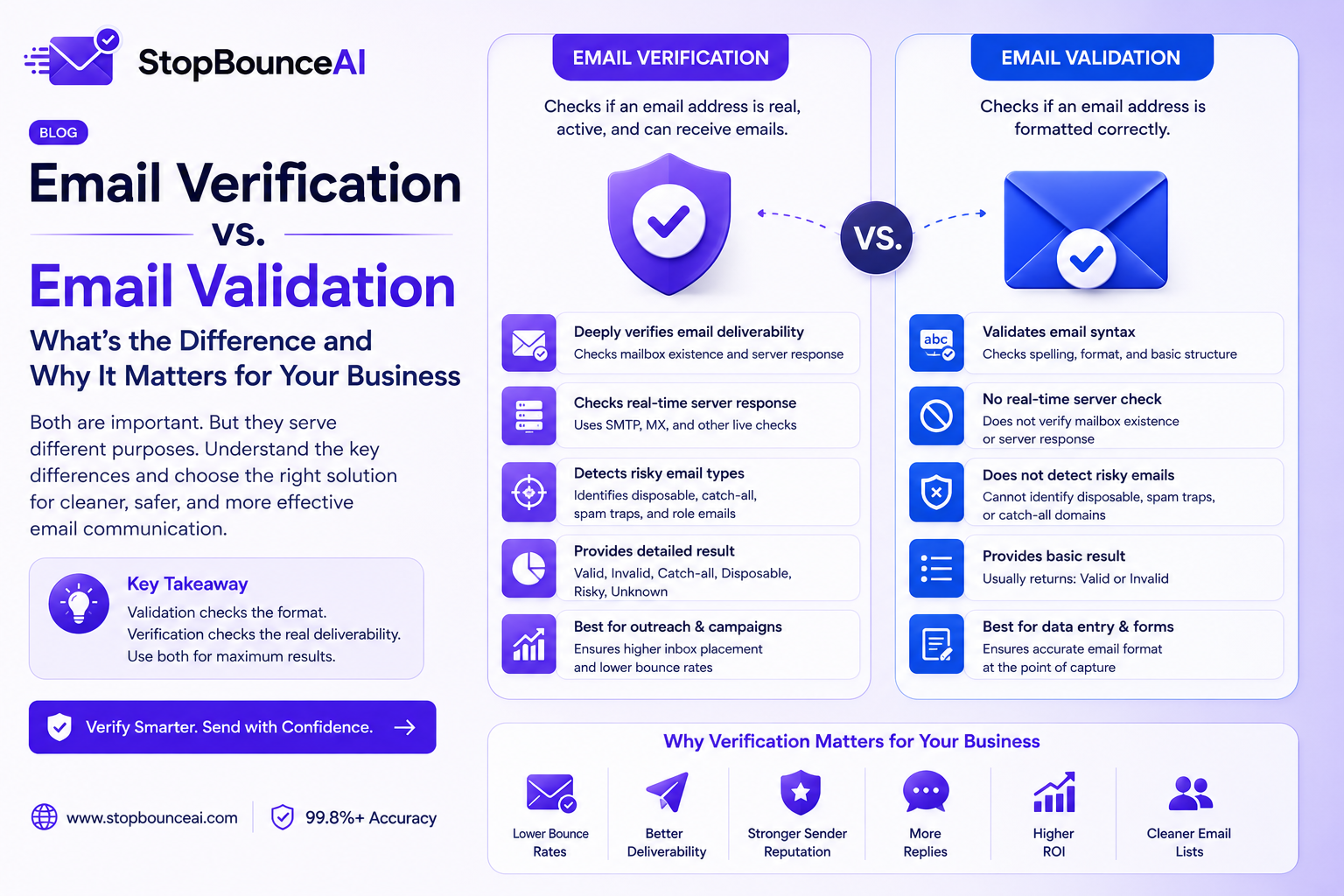
What Is the Difference Between Email Verification and Deliverability?
Email verification and email deliverability are related but different.
Email Verification
Email verification evaluates the recipient email address and related technical signals.
Email Deliverability
Email deliverability refers to the broader ability of your emails to reach recipients successfully and, where possible, the inbox.
Verification is only one part of deliverability.
Other important factors include:
- SPF
- DKIM
- DMARC
- Sender reputation
- Domain reputation
- Email content
- Sending volume
- Recipient engagement
- Spam complaints
- Receiving-server policies
A verified email address does not guarantee inbox placement.
Why 50+ Verification Checks Matter
A single email check cannot provide a complete picture of email quality. That's why advanced verification platforms can use multiple checkpoints. Depending on the platform and verification method, these can include checks related to:
- Syntax
- Domain
- MX records
- SMTP
- Mailbox signals
- Disposable providers
- Catch-all domains
- Spam traps
- Risk indicators
- Domain infrastructure
Using multiple signals can provide a more detailed understanding of an email address than basic format validation alone.
How StopBounceAI Helps
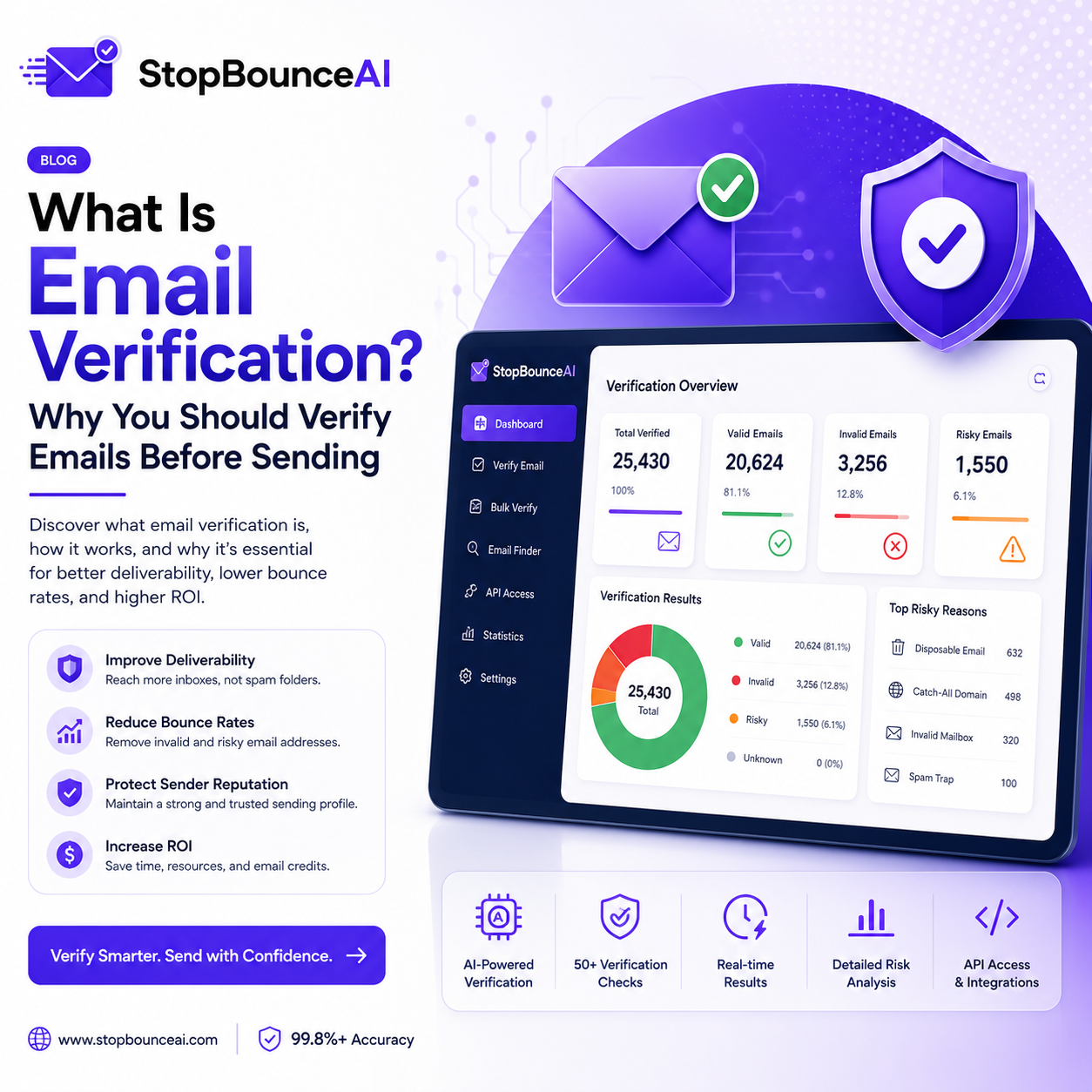
StopBounceAI is an AI-powered email verification and email finder platform designed to help businesses identify invalid, disposable, catch-all, spam, and risky email addresses. The platform combines multiple verification signals to help businesses make better decisions about their email data.
AI-Powered Verification
Analyze email addresses using intelligent verification and risk analysis.
50+ Verification Checks
Evaluate email addresses across multiple technical and risk-related checkpoints.
Real-Time Results
Get verification results quickly before using contacts in your campaigns.
Detailed Risk Analysis
Understand different verification outcomes instead of relying only on a simple valid or invalid label.
Bulk Email Verification
Process large email databases efficiently.
Email Finder
Find professional email addresses and verify them before using them for outreach.
API Access
Integrate email verification into applications, CRMs, databases, and automated workflows.
A Smarter Email Verification Workflow
Building a reliable email process doesn't have to be complicated.
Follow these steps:
- Collect Your Contacts - Gather leads from your website, CRM, prospecting tools, events, databases, or other sources.
- Clean Your Data - Remove duplicates and obvious formatting errors.
- Verify Your Emails - Use an email verification platform to evaluate the addresses.
- Analyze the Results - Separate valid, invalid, disposable, catch-all, risky, and unknown addresses.
- Build Your Campaign List - Use the appropriate contacts for your campaign.
- Send Responsibly - Follow good email-sending and authentication practices.
- Monitor Performance - Track bounces, engagement, replies, and other campaign metrics.
Can AI Email Verification Guarantee 100% Deliverability?
No email verification system can guarantee 100% inbox placement or delivery.
Email delivery depends on many factors beyond the recipient address. These include:
- Sender reputation
- Domain reputation
- SPF
- DKIM
- DMARC
- Sending behavior
- Email content
- Recipient engagement
- Spam complaints
- Receiving-server policies
The purpose of email verification is to improve your recipient-data quality and reduce avoidable problems before sending.
Frequently Asked Questions
What is AI-powered email verification?
AI-powered email verification uses automated analysis and multiple signals to evaluate email addresses for validity, deliverability, and potential risk.
Can AI email verification reduce bounce rates?
It can help reduce avoidable bounces by identifying invalid and potentially problematic addresses before sending.
What email addresses can StopBounceAI detect?
StopBounceAI is designed to identify invalid, disposable, catch-all, spam, and risky email addresses.
Is email verification useful for cold email?
Yes. Verifying prospect data before cold email campaigns can help improve list quality and reduce avoidable delivery failures.
Is email verification useful for B2B lead generation?
Yes. B2B databases change frequently, and verification can help sales and lead-generation teams maintain cleaner contact data.
Can I verify emails in bulk?
Yes. Bulk verification allows businesses to process large contact databases efficiently.
Does email verification guarantee inbox placement?
No. Verification can help evaluate recipient data, but inbox placement also depends on sender reputation, authentication, engagement, content, sending practices, and receiving-server policies.
Conclusion
Email deliverability starts with good data. If your email database contains invalid, outdated, disposable, catch-all, spam, or risky addresses, your campaigns may waste resources and experience unnecessary delivery problems. AI-powered email verification provides a smarter way to evaluate your contact data before sending.
Instead of sending blindly, you can:
Find → Verify → Analyze → Clean → Send
With StopBounceAI, businesses can use AI-powered email verification, 50+ verification checks, real-time results, detailed risk analysis, bulk verification, email finding, and API access to build cleaner and more reliable email workflows.
Verify Smarter. Send With Confidence.
StopBounceAI - AI-Powered Email Verification & Finder
Detect invalid, disposable, catch-all, spam, and risky emails before they become a problem for your campaigns.